The Tarot is a profound system of archetypal symbolism contained within a 78-card deck, serving as a powerful mirror for human consciousness and life experiences. Its ultimate importance lies not in predictive fortune-telling, but in its utility as a psychological and meditative tool for self-reflection, spiritual development, and intuitive decision-making.
The deck is divided into the 22 cards of the Major Arcana, which represent significant karmic shifts and overarching macro-phases of life's journey (famously framed by Joseph Campbell as the "Hero's Journey"), and the 56 cards of the Minor Arcana, which govern the day-to-day micro-experiences of thoughts, emotions, actions, and material realities. Every card is dense with esoteric details—from astrological glyphs and numerological patterns to specific elemental color palettes, such as bright yellows signifying intellect and illumination, or deep blues conveying intuition and the subconscious.
Rather than a mystical roadmap of an unchangeable future, the Tarot is actually used in modern practice to map out present energetic alignments, unlock creative roadblocks, and visually contextualize personal dilemmas, allowing individuals to gain clarity by engaging with a universal symbolic language.
The Empress: The Garden of Creation
The Empress is the third card of the Major Arcana, and she appears as a figure of abundance, beauty, fertility, and creation. Seated upon her throne amid a flourishing landscape, she is surrounded by the visible evidence of life: trees, grain, flowers, flowing water, and the richness of the earth. Nothing about her environment suggests scarcity. The world around her is alive, productive, and generous. Where the High Priestess sits before the veil guarding the hidden mysteries, the Empress sits within the garden, surrounded by the manifestation of those mysteries.
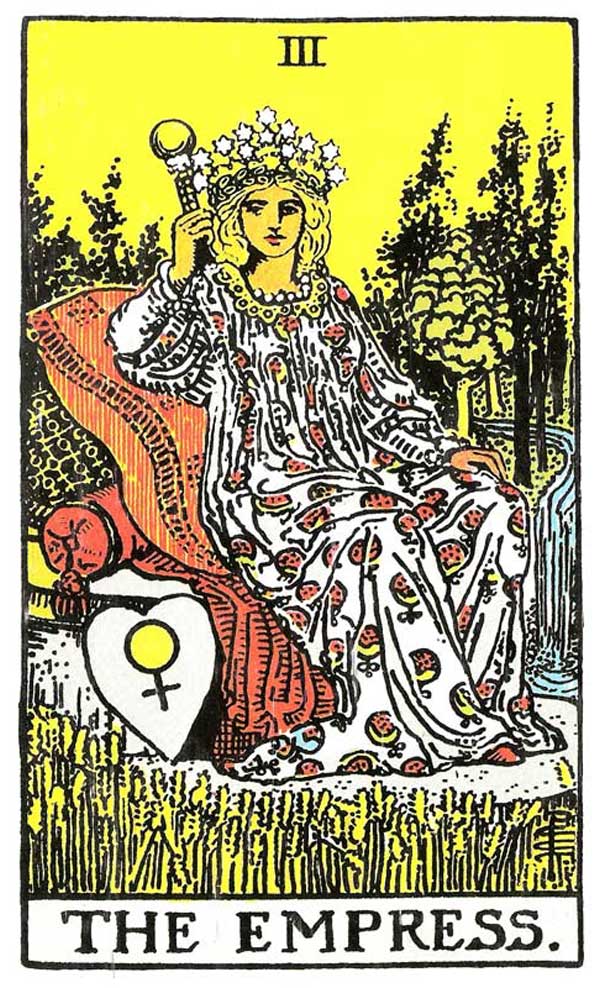 Her position as the third card is significant. The first card, the Magician, represents the conscious will and the ability to act upon the world. The second, the High Priestess, turns inward toward intuition, mystery, and the unseen. With the Empress, what has been conceived within the unseen begins to take form. One becomes two, and from the interaction of two comes three: something new is born. The Empress therefore represents the principle of generation—the movement from potential into manifestation, from thought into form, and from the invisible into the visible.
The woman herself is crowned with stars, suggesting that the earthly world she represents is not separate from the heavens. The stars above her head remind us that the patterns of creation extend beyond the individual and participate in a greater order. Her crown can be understood as a sign of the celestial wisdom that governs the natural world, while her position upon the earth reminds us that the divine is not encountered only in distant or inaccessible places. It may also be perceived in the rhythms of nature, the changing seasons, the growth of a seed, the movement of water, and the mysterious process by which life continually renews itself.
Her robe is decorated with pomegranates, an ancient symbol of fertility, abundance, and the mysteries of life and death. The pomegranate contains within a single fruit a multitude of seeds, each carrying the possibility of another generation. It therefore becomes an especially fitting emblem for the Empress. What appears externally as one thing may contain within itself countless possibilities waiting to be brought into existence. The cushions and furnishings bearing the symbol of Venus reinforce this theme. Venus is associated with love, beauty, attraction, harmony, pleasure, and fertility—the forces that draw things together and allow new forms of life and creation to emerge.
The river flowing through the landscape adds another important dimension. Water has long been associated with life, emotion, purification, wisdom, and the movement of spiritual influence into the material world. A river does not remain fixed; it moves, nourishes, shapes the land, and eventually finds its way toward the greater waters. In this sense, the Empress teaches that creation is not merely an act of producing something but a continual process of movement, nourishment, transformation, and renewal.
The abundance surrounding the Empress should not be understood simply as material luxury. Her wealth is the wealth of life itself. She reminds us that creation requires nourishment. An idea needs attention. A relationship requires care. A child requires protection and love. A garden must be cultivated. A community flourishes when its members contribute to its well-being. Even the most inspired vision will remain only a possibility unless it is given the conditions necessary to grow.
This is one of the deeper lessons of the Empress. The creative principle is not simply the ability to produce; it is the ability to nurture what has been produced. Creation and preservation therefore belong together. To bring something into existence is only the beginning. It must then be protected, cultivated, and given room to develop.
The Empress consequently speaks to every form of creativity. She may represent motherhood and pregnancy, but her symbolism extends far beyond biological fertility. She can signify the birth of an idea, the beginning of a business, the development of an artistic work, the strengthening of a relationship, or the creation of something that did not previously exist. A project that has remained only an idea may now be ready to become tangible. Something conceived in the mind may be brought into the hands.
There is also a lesson here concerning our relationship with ourselves. The Empress does not represent creation through exhaustion or self-denial. She reminds us that the creator must also be nourished. Rest, beauty, food, companionship, nature, affection, and pleasure are not necessarily distractions from meaningful work; they can provide the conditions in which meaningful work becomes possible. To care for oneself is, in this sense, to tend the soil from which one's own creativity grows.
The Empress therefore invites us back into relationship with the natural world. Her garden is not merely decorative scenery. It represents the great living environment of which humanity is a part. We may construct buildings, establish cities, create machines, and surround ourselves with technology, yet we remain dependent upon the ancient processes of the earth. We still require air, water, food, sunlight, and the countless cycles of nature that existed long before us.
Her lesson is particularly powerful because nature does not create through chaos alone. The garden is abundant because it is ordered. The seed follows its nature. The seasons follow their cycles. The river follows its course. The fruit develops according to a pattern contained within the seed. Beneath the visible abundance lies an invisible order.
This is where the Empress begins to touch the deeper mysteries of creation. The visible world can be contemplated as the expression of principles that precede it. Form follows pattern. Life follows laws. Proportion appears throughout nature. The same world that provides beauty also reveals order. To contemplate creation, therefore, is to contemplate the wisdom expressed through creation.
In this sense, the Empress may be understood as standing at the meeting point between the spiritual and material worlds. She does not abandon the invisible mystery represented by the High Priestess; she gives that mystery expression. What was hidden becomes visible. What was potential becomes actual. The divine pattern becomes reflected in the created world.
The number three deepens this symbolism. Two points establish a relationship, but the third point creates a new form. Three points establish a triangle; three dimensions give depth to space; three stages allow a process to move from beginning through development toward completion. Three therefore carries the idea of manifestation and relationship. The Empress, as the third Major Arcanum, embodies this movement from polarity into generation.
This movement can also be contemplated through the sacred language of creation. The infinite and unknowable source gives rise to distinction; distinction creates relationship; relationship allows manifestation. The Empress represents that generative stage in which the invisible becomes capable of being experienced through form. She is therefore not merely "the mother" but the principle through which the world becomes fruitful.
Her connection with Venus adds another dimension to this mystery. Beauty itself can be understood as a form of harmony. We recognize beauty when parts exist in a pleasing relationship with one another. Love similarly draws separate individuals into relationship. Attraction brings things together. Harmony allows them to coexist. In the Empress, beauty, love, fertility, and creation become different expressions of the same underlying principle: the power to unite, nourish, and bring forth something greater.
For this reason, the Empress is often a favorable card when questions concern relationships. She may indicate affection, tenderness, stability, commitment, and the desire to build something together. In an established relationship, she can represent the growth of a shared life. In a new relationship, she may indicate that something has the potential to develop into something deeper and more enduring. Because the Empress is so strongly associated with generation and family, she may also point toward marriage, motherhood, pregnancy, or the formation of a family, although the surrounding cards and circumstances determine how literally that symbolism should be understood.
Her influence extends just as naturally into work and vocation. The Empress encourages the cultivation of ideas rather than allowing them to remain unrealized possibilities. A creative project may be ready to develop. A workplace may benefit from greater cooperation and care. A person may find that their greatest strength is not simply directing others but creating an environment in which others can flourish. Leadership, in this sense, becomes an act of cultivation.
The same principle applies to material prosperity. The Empress is associated with abundance, but abundance does not necessarily mean sudden wealth. It can mean having enough, recognizing what one already possesses, and understanding that prosperity becomes meaningful when it can be shared. The Empress does not clutch her abundance to herself. She sits in the midst of it, allowing the garden around her to flourish.
This makes generosity another expression of her nature. Food shared with another person, knowledge passed to a student, encouragement offered to a struggling friend, time given to a community, or a skill used for the benefit of others can all become forms of Empress energy. Abundance reaches its fullest expression when it becomes nourishment.
The Empress can therefore be understood as the great cultivator. She asks not only, "What do you wish to create?" but also, "What are you willing to nurture?" An idea without discipline remains an idea. A relationship without attention withers. A community without participation declines. A garden without cultivation eventually becomes overgrown. Creation requires continuing care.
When the Empress appears as an expression of another person's feelings, she may indicate warmth, affection, admiration, attraction, and a desire to nurture a relationship. The person may see another as beautiful, comforting, inspiring, or worthy of investment. There is a sense of wanting something to grow. Her emotional character is generous rather than possessive, suggesting affection that seeks to encourage rather than control.
As an indication of action, the Empress encourages cultivation. Tend to what matters. Feed the idea that deserves to become reality. Give attention to the relationship that has the potential to grow. Spend time in nature. Create something with your hands. Cook a meal, plant something, make something beautiful, repair something neglected, or simply provide a place where another person can feel welcome. These ordinary acts can carry profound significance because they participate in the same principle symbolized by the Empress: bringing life into the world and helping it flourish.
There is also an important distinction between the Empress and the Magician. The Magician demonstrates the power to act upon the world, while the Empress demonstrates the power to cultivate the world. The Magician takes the tools before him and directs them toward a purpose. The Empress creates the conditions in which something can grow. One emphasizes will; the other emphasizes nourishment. Together they suggest that creation requires both intention and care.
And following the High Priestess, the progression becomes even more profound. The High Priestess guards the mystery behind the veil. The Empress reveals that the mystery is already expressing itself all around us. The garden becomes a living temple. The river becomes a symbol of continual movement. The stars become reminders of celestial order. The fruit becomes a vessel of future generations. The earth itself becomes a reflection of a wisdom that existed before humanity gave it names.
The Empress therefore invites us to look at creation differently. The world is not merely something to possess or consume. It is something to encounter, cultivate, protect, and understand. Her abundance is not simply a promise of receiving more; it is a reminder that we are participants in the process of creation.
The Empress sits quietly within her garden because she does not need to force the world to produce. She understands that the seed already contains its potential. Her task is to provide the conditions in which that potential can unfold.
And perhaps this is the deepest lesson of the third card of the Tarot:
The Magician teaches us that we have the power to create.
The High Priestess teaches us that creation begins in mystery.
The Empress teaches us that what is created must be nurtured until it can bear fruit.
The hidden wisdom has crossed the threshold.
The seed has been planted.
Now it must be given life.



