There is an old truth, seldom spoken aloud yet quietly understood by those who labor in the quarries of life. Masonry is not learned all at once, nor is it ever truly completed. It is not bestowed in a single evening, nor confined to the walls of this Lodge. Rather, it reveals itself slowly. Sometimes in moments of solemn reflection, and sometimes, quite unexpectedly, in the ordinary passages of daily life.
Recently I have found myself engaged in what may be the most humbling and instructive undertaking of my Masonic journey and not within a tiled Lodge, but within the walls of my own home. I would like to tell you about raising a four-year-old Mason.
Now, most of those who regularly attend this Lodge already know who I speak of. You have seen him walking and sometimes running through this building. You have watched him pass among you in a small suit or tuxedo, offering his hand in greeting, attempting with all the seriousness of his young heart to conduct himself as a gentleman among Masons. In many ways, he has become a familiar presence within this building, being recognized, welcomed, and loved by the Brethren.
I would be dishonest if I did not confess that he is often the focal point of my pride, particularly when I see him attentive within the Lodge, respectful to the Brethren, and eager to belong to something greater than himself.
Yet it is not in those moments that I have learned the most. It is in the quiet moments. The unguarded moments. The moments when he is asked simple questions and at times, answers them in the most unexpected ways.
For when one raises a child, he does not merely instruct but reveals himself. Every inconsistency is exposed. Every virtue claimed is tested. And every lesson spoken aloud is quietly weighed against the example that stands behind it.
In Masonry, we speak often of building or shaping rough material into something fit for a noble purpose. But I have learned that in guiding a young child, one is not so much the master craftsman as he is the barrier of burden or rather a common workman, entrusted with its care before the marks of the world are set too deeply upon it.
At four years of age, a child is already keenly aware of fairness, deeply sensitive to truth, and instinctively responsive to love. He knows when something is right long before he can explain why. In a way, he is not far from the position of that of an Entered Apprentice, standing at the threshold, perceiving more than he understands, and learning far more from observation than from instruction. It was on his first day of pre-school that I encountered one of those moments which still humbles me to this day.
Like many children, he was asked a simple question: “What do you want to be when you grow up?”
His answer was immediate, it was concise, and it was unwavering. “I want to be a Freemason like my dad.”
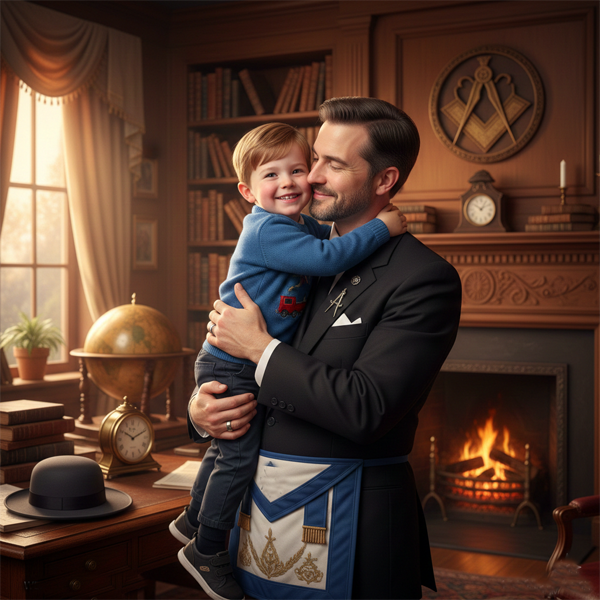 Please believe me when I say, no title I have ever held, no office I have ever served, no recognition I have ever received within this fraternity or in life has carried the weight of that simple sentence. For in it, I heard not ambition, but imitation. Not aspiration, but observation. He did not speak of wealth, nor power, nor position. He only spoke of character, even though he does not yet know the word or the meaning of it.
In that moment, I understood something profound: My son is learning Masonry from me whether I intend to teach it or not. Not from ritual, not from lectures, not from catechisms, but from conduct.
Most recently, my wife asked him a series of questions (one of those Facebook trends). He was
asked more than twenty questions in all, as part of a simple questionnaire. Most were ordinary. Some were expected. But some of them struck me with an uncommon force. When asked, “Where do babies come from?” He answered simply, “Babies come from their mama’s bellies.” But when asked, “Where did you come from?” His answer was not biological. It was theological. “I come from God.” And when asked, “Why are you so cute?” He did not speak of himself at all. His response was simply: “I don’t know....just because God made me cute.”
Consider the theology of a child.
No ego.
No vanity.
No pride of self-creation.
Only gratitude.
Only origin.
Only dependence upon the Divine.
As I stood there, an obligated Mason, a grown man, and realized that this child possessed a humility and a spiritual clarity that many adults labor a lifetime to recover.
This brings me to another truth I would like to speak about within the Lodge.
Freemasonry is not a religion.
But it is most certainly a school of reverence. It has not replaced my faith, but it has refined it. It has not altered my God, but it has drawn me nearer to Him.
I have heard this same confession spoken quietly by other Brothers within my own Lodge: That while Masonry does not dictate creed, it cultivates conscience. While it does not prescribe doctrine, it disciplines the soul. While it does not command worship, it encourages reverence.
It teaches a man to walk uprightly before his God, to deal justly with his neighbor, and to govern himself with restraint, humility, and charity. I have found that the truest test of these lessons is not within this Lodge room, but within the home.
For my son does not know our obligations, but he knows my patience.
He does not know our rituals, but he knows my temper.
He does not know our lectures, but he knows my mercy.
He does not know our working tools, but he knows my example.
In this way I have come to understand that fatherhood itself can be Masonic labor.
A child is the living mirror. They reflect our virtues and magnify our faults. They expose hypocrisy without accusation. They call you to truth without rebuke. They demand consistency without ever asking for it.
We speak of leaving a legacy. We speak of building for the future. We speak of preserving the Craft for generations yet unborn. But the greatest legacy we leave is not found in buildings, nor in charters, nor in titles, nor in regalia, but in the hearts of those who watch us most closely.
And if a four-year-old boy can look at his parents and say, “I want to be a Freemason like my dad,” then that father must labor daily to be worthy of the Craft he represents. It is an ongoing goal that must be pursued daily. For he is no longer shaping only his own stone but helping in shaping another’s foundation.
May we all remember that our Masonry does not end when we leave this Lodge. It walks beside us into our homes, it sits with us at our tables, it speaks through our conduct, and it lives on in those who learn from us. Not by what we say, but by who we are.
So may we labor well, may we build carefully, and may we always remember that the youngest eyes, either in physical age or Masonic age often see the clearest truths.
Bro. Trevor Merriman
Junior Deacon



