Long before the stone of the Temple was laid at Jerusalem, and long before the first initiate walked between the pillars, there was another temple, an invisible one, built not of stone but of thought. This was the Memory Palace. Known in the classical world as the Method of Loci, it was practiced by orators in Greece and Rome, who required not parchment nor ink to recall their discourses, but the ordered chambers of their imagination.
The Roman philosopher Cicero recounts the tale of Simonides of Ceos, the poet, who, after a banquet hall collapsed, was able to recall every guest by remembering where they had sat. From this sprang the art of memory, the ability to assign an idea, a word, or a passage to a place in the mental architecture of one’s own creation. Medieval mystics adopted it as well, not merely to recall sermons, but to ascend in contemplation through chambers of the soul. Thus, the Memory Palace became not only an intellectual tool, but a ladder of Jacob, a bridge between earth and heaven.
Freemasonry, inheritor of both ancient mystery and medieval symbolism, is uniquely suited to employ this method. Our Craft is one of ritual, allegory, and symbolism. But, if the symbols within are not housed properly, they scatter like dust in the wind. The palace of memory provides the walls to keep them whole.
What is a Memory Palace?
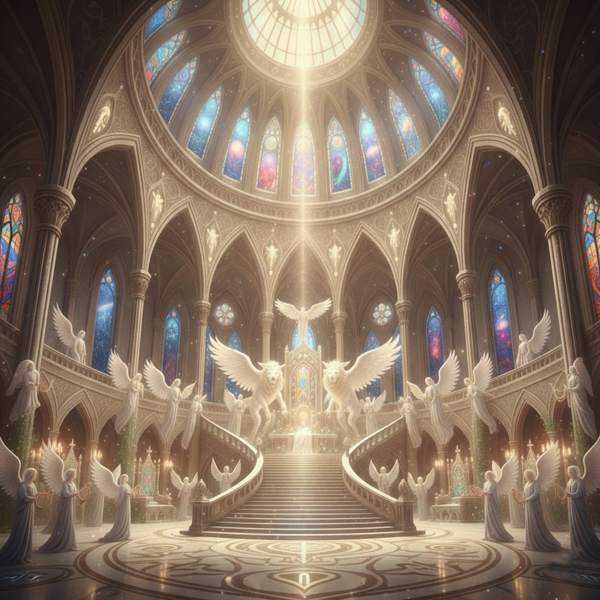
A Memory Palace is an imagined structure within the mind, as detailed and vivid as any cathedral built by human hands. It may be a hall you have walked through in your youth, a lodge room in which you sat in silent awe, or an entirely new edifice constructed by imagination. Within its corridors, you place emblems, figures, and stations, each corresponding to a word, phrase, or idea you wish to retain. The process is thus: Construct or Choose the Place – Select a building, real or imagined, which you can walk through clearly in your mind.
Assign Stations – Each room or location becomes a “station” where a portion of ritual is deposited.
Imprint with Symbol – Place within that station a vivid, often exaggerated symbol which represents the line or concept you wish to recall.
Walk the Path – In your mind’s eye, travel from station to station, rehearsing each symbol until the whole unfolds in order, like a procession of brethren in lodge.
No discussion of the art of memory would be complete without mention of Giordano Bruno (1548–1600), the Dominican friar, philosopher, and mystic who elevated the Memory Palace to cosmic proportions. Bruno saw the act of memory not merely as a convenience for orators, but as a sacred discipline. For him, memory was the very key to unlocking divine truth.
Where the ancients walked through halls and temples in their imagination, Bruno walked through the heavens. He crafted elaborate memory wheels, diagrams of concentric circles inscribed with symbols, deities, letters, and images. These he aligned with the stars and constellations, so that the very architecture of the cosmos became his palace. In his vision, memory was not bound to the earthly temple but expanded into the celestial lodge of infinite stars.
Bruno believed that by training the memory through such palatial constructions, man could unite the finite mind with the infinite Mind, the very Logos itself. This was dangerous theology in his day, for it implied that the divine spark within man could be kindled without the mediation of priest or church.
For this heresy, he was condemned and burned in the Campo de’ Fiori in Rome. Yet the fire did not extinguish his art, it spread, invisibly, through Europe, finding echoes in the mystical and speculative traditions that later informed Freemasonry.
For the Mason, Bruno’s lesson is clear. The palace of memory is not merely a technique for rote recall. It is a spiritual practice, a discipline of inner architecture by which the soul learns to arrange itself according to divine order. When we build a palace to house our ritual, we walk in Bruno’s footsteps, erecting within the mind a temple of Light that reflects the greater cosmos.
Giordano Bruno’s genius lay in transforming the art of memory from mere rooms and corridors into a cosmic architecture. He arranged symbols and letters on concentric wheels, turning the mind itself into a universe where ideas orbited like stars. For the Mason, this concept can be applied directly to ritual memorization, creating a dynamic, visual, and spatial tool that transcends simple rote learning.
Constructing Your Celestial Memory Wheel
Select the Core Theme – At the center of your wheel, place the most fundamental concept of your ritual. In the Entered Apprentice degree, this might be the obligation; in the Fellowcraft, the tracing board; and in the Master Mason, the legend of Hiram. This center is the “Sun” of your memory cosmos.
Create Concentric Rings – Around your center, draw rings that represent successive stages or sections of the ritual. Each ring is a level of initiation, a path that must be traversed in order. For instance:
Ring 1: Signs, tokens, and words.
Ring 2: Lectures and charges.
Ring 3: Movements and perambulations.
Assign Symbols to Positions – Within each ring, assign a vivid symbol to each phrase or concept. Bruno emphasized exaggeration and emotional intensity. The more striking the image, the stronger the memory imprint. For example:
A hand laid upon a book could signify the obligation given on the VSL.
Each officer jewel could denote certain parts of ritual for that specific officer. The 3, 5, and 7 steps on the way to the Sanctum Sanctorum could each glow with a different color, signifying the different parts of the stair lecture in the Fellowcraft Degree.
Orbit Your Mind – Mentally “walk” your wheel, moving outward from the Sun through each concentric ring. As the eye moves along the wheel, the ritual unfolds naturally. Each station triggers the next, ensuring order and completeness.
Layer Additional Wheels – Bruno often stacked multiple wheels atop one another, creating complex hierarchies of memory. The Mason may create a second wheel for symbolic correspondences, moral lessons, or allegorical meanings, allowing a dual recollection of words and wisdom simultaneously.
Practical Example: Entered Apprentice Degree
Center (Sun): Obligation
First Ring: Signs, tokens, and grip
Second Ring: Working Tools (24-inch gage and common gavel)
Third Ring: Lecture points (moral lessons)
Outer Ring: Candidate’s perambulations and ceremonial movements
By spinning this wheel in imagination, a brother can traverse the entire degree in order, recalling not just words but the experience of initiation. Each rotation strengthens memory, just as repeating the ritual in lodge strengthens the soul.
The celestial wheel is more than a mnemonic. It mirrors the structure of the cosmos itself, reflecting the Masonic belief that man is a microcosm of the universe. To move the mind along these rings is to move the soul through the divine order, aligning intellect with spirit. I n this, Bruno’s memory art becomes a secret lodge of the mind, a private temple where ritual, morality, and contemplation coexist. Masonic ritual is a tapestry woven of words, movements, and sacred emblems. To memorize it is not to cram the mind with syllables, but to inhabit the temple of memory. Here is how one may apply the Palace and celestial wheel to our work:
The Lodge Room as Palace: Imagine the lodge itself as your primary palace. The East, West, and South naturally divide the ritual into stations. Each officer’s chair may hold a scene of the lecture, each column an emblem, and each jewel a phrase. When the mind rehearses the work, it is not merely recalling lines, but walking the temple.
The Pillars as Gatekeepers: At the entrance to your palace, place the great pillars J. and B. Upon one, carve the first words of obligation. Upon the other, the sign and token that follow. Passing between them in imagination, the ritual begins.
The Journey of the Candidate: As the candidate is led about the lodge, so too, may you journey in your palace. Each perambulation may hold key phrases, obligations, and charges. By “walking the floor” mentally, the work reveals itself step by step.
Emblems in the Chamber: The working tools, the trestleboard, the rough and perfect ashlar, each of these may serve as mnemonic anchors. Exaggerate them in the imagination. The gavel striking sparks, the compasses glowing, and the ashlar gleaming like crystal. These living images cling to the memory where plain words may slip.
The Alchemy of Memory
Just as alchemists transmuted lead to gold, we transmute fleeting sound into enduring recollection. The palace is the vessel; the ritual is the prima materia; and the vivid symbol is the fire that fixes it. The Brother who builds his palace is not merely memorizing, he is initiating himself anew, for while walking those inner chambers he rehearses not just words but the entire mystery.
To labor in this art is to understand that ritual does not live on the printed page. It lives within the temple of the mind, and in the silence of contemplation it is raised to life. The Memory Palace and celestial wheel become, in truth, a Masonic edifice, a secret lodge within the self, wherein the ritual is preserved against the corruption of forgetfulness.
Brethren, to commit our ritual to memory is not a burden but a privilege. To speak its words without hesitation, to unfold its allegories with precision, is to lay another stone in that invisible temple built to the glory of the Great Architect. The Memory Palace is the craftsman’s tool, Bruno’s celestial wheel is the mystic’s ladder, and together they form the Mason’s inner lodge. Build them well, and you shall never lack a place where the Light shines in secret splendor.



